The Sun peaks in the sky at true noon. For example, at the latitude of Bordeaux (45°N), it reaches a height of 45° on the horizon on the day of the equinox (spring or autumn).
We can graphically represent the variation of the height of the Sun on the horizon during a day. On Geogebra, we trace the sinusoid y = 45 sin (x. 2π /1 440) (in green) and the line y = 45 (black).
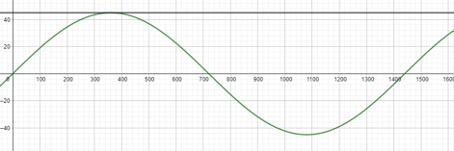
Height of the Sun at the equinox at latitude 45° (over one day)
For an observer located at the latitude of Bordeaux on an equinox day, the Sun rises (altitude zero) at minute zero. It peaks at 45° above the horizon 6 hours later, or at minute 360 (6 x 60 = 360). The Sun sets 12 hours later (minute 720) and rises again 24 hours later, at minute 1440 (1440 = 24 x 60). A day is 1,440 minutes.
For all other days of the year, we shift the green curve of the Sun’s declination. That is to say from +23.6° at the summer solstice to -23.6° at the winter solstice. Whatever the date, it’s the same curve, just shifted up or down.
The graph below is a zoom on the moment when the Sun reaches its maximum, at minute 360 (the graph represents 45°, but the curve is the same whatever the day):

We see that the sinusoid is practically indistinguishable from the straight line for at least 10 minutes (from minute 355 to 365).
Since the Earth rotates 360° in 24 hours, it travels 21,600 minutes of angle (360 x 60 = 21,600) in 1,440 watch minutes. So the Earth rotates 15 minutes of angle per minute of clock (21,600 / 1,440 = 15). An uncertainty of around 10 minutes on the precise time of noon leads to an uncertainty of 150 minutes, or 150 nautical miles.
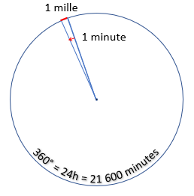 |
· The nautical mile is defined as the distance on Earth corresponding to one minute of angle. · In a complete revolution, there are 360 degrees of 60 minutes, or 21,600 minutes. · The Earth is 40,000 km in circumference (by construction, since the meter is defined as one millionth of the quarter of the earth’s meridian). · The nautical mile therefore corresponds to 40,000 km / 21,600 = 1.852 km. |