
We know that the days of the week correspond to the planets visible to the naked eye. Let’s start by clarifying a point of vocabulary: planet in Greek means “wandering star”, that is to say a star which moves in relation to the celestial vault, the “sphere of the fixed”. According to this definition, the Moon and the Sun are planets.
Thus, each day has its own planet: Monday is the day of the Moon, Tuesday that of Mars, etc. But why in this order? (See also: Every day has its own planet? Not quite!)
First, this is not the order of distance from the Sun as we know it today. Otherwise, we would have: Sunday, Wednesday, Friday, Monday, Tuesday, Thursday, Saturday (or the other way around…).
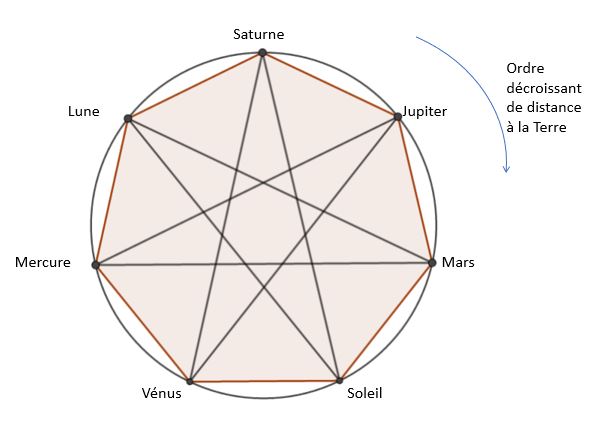
Oddly, this is not the order in which the ancients arranged the planets either. Indeed, they had the following order: Saturn, Jupiter, Mars, Sun, Venus, Mercury, Moon, ranking them from furthest to closest to Earth (See also: “In what order did the Ancients place the planets?” ).
Then, why this order?
To understand it, we have to go through the Egyptians, who divided the day into 24 hours (which we still do) and who gave each hour of the day the name of a planet, according to the order of distance from the Earth, as they knew it. On the first day of the week, the first hour was logically attributed to the Sun, the second to Venus, etc.
24 hours later, the first hour of the next day is devoted to the Moon, etc.
Indeed, 3 is the remainder of the division of the 24-hour day by 7 planets (in other words: 24 is equal to 3 x 7 + 3). So, from the Sun, we “jump” 3, then another 3, etc.
Thus, the following graph gives the order of the days of the week, as we know it today:
The order of the days of the week is therefore based on two archaisms:
- The order in which the Ancients placed the planets (based on the old geocentric view) and
- How planets were assigned to each hour of the day.