Plant a vertical stick in flat ground (gnomon). Locate the end of the shadow (by placing a pebble, or by planting another stick). Wait about half an hour. The sun has moved, and so has the shadow. Locate the new location of the shadow end. Draw a straight line between these two locations: this is the west-east axis. The first point identified is the West, the second is the East. So, inevitably, if we draw the perpendicular to this line, we have the North-South axis: the gnomon points to the south and the perpendicular gives the north.
It’s less accurate than the first method, but much faster.
Why is it not very precise?
A gnomon’s shadow moves in a straight line only at the equinox (about March 21 and September 23). On all other days of the year, the trace is a hyperbole, more or less concave or convex, depending on the date.
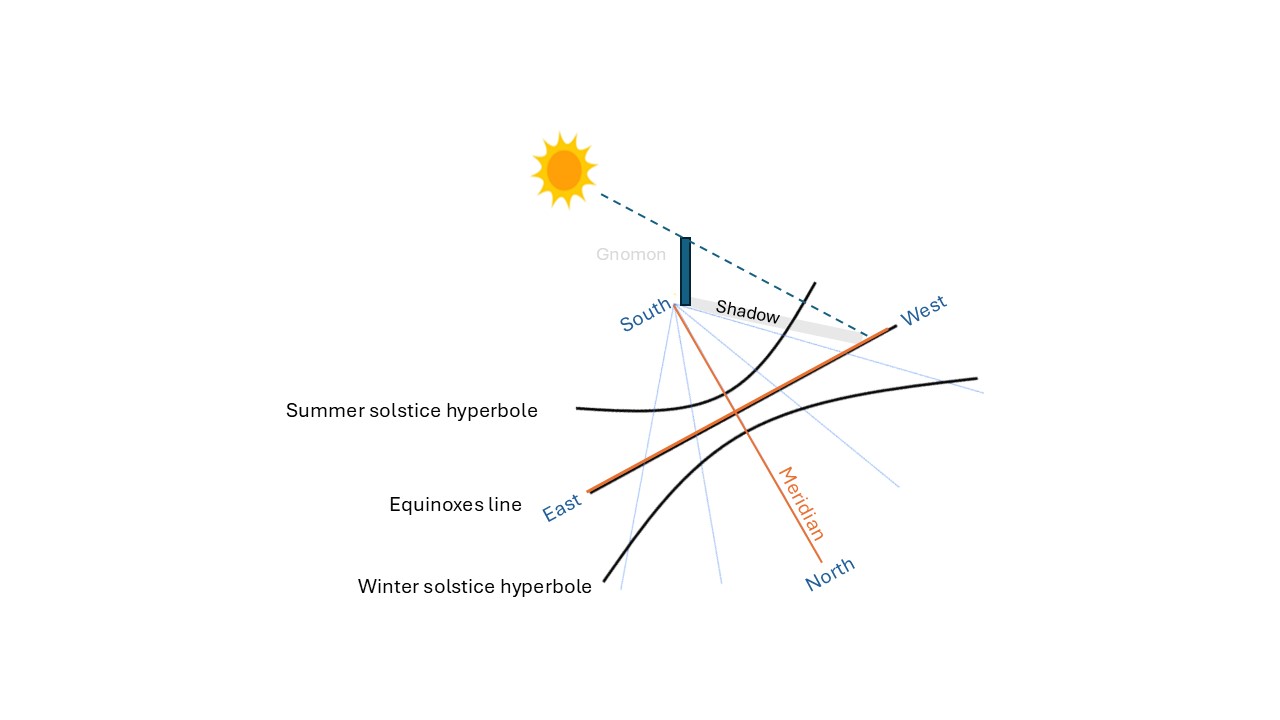 |
The tip of a gnomon’s shadow traces a conic pattern on flat ground. The curvature of this hyperbola varies throughout the year. Twice a year, at the equinox, the curvature is zero and the trace of the gnomon on the ground is a straight line, perfectly aligned East-West. It is on this principle that the method is based. So if we do the survey in September and March, it will be pretty good, because the trace of the gnomon’s shadow is close to a line. The rest of the year, the reading will be rather good around noon. It will be most incorrect in the middle of summer or in the middle of winter and especially in the early morning or late afternoon, when the portion of hyperbole is the most curved.
| Finding North without a compass | ||
|
1 |
With a stick (and the day) |
|
|
2 |
With a stick (and 30 minutes) |
|
|
3 |
With a regular watch |
|
|
4 |
With a pilot watch |
|
|
5 |
With a double sundial |
|