To make sure it’s clear, here are some additional comments:
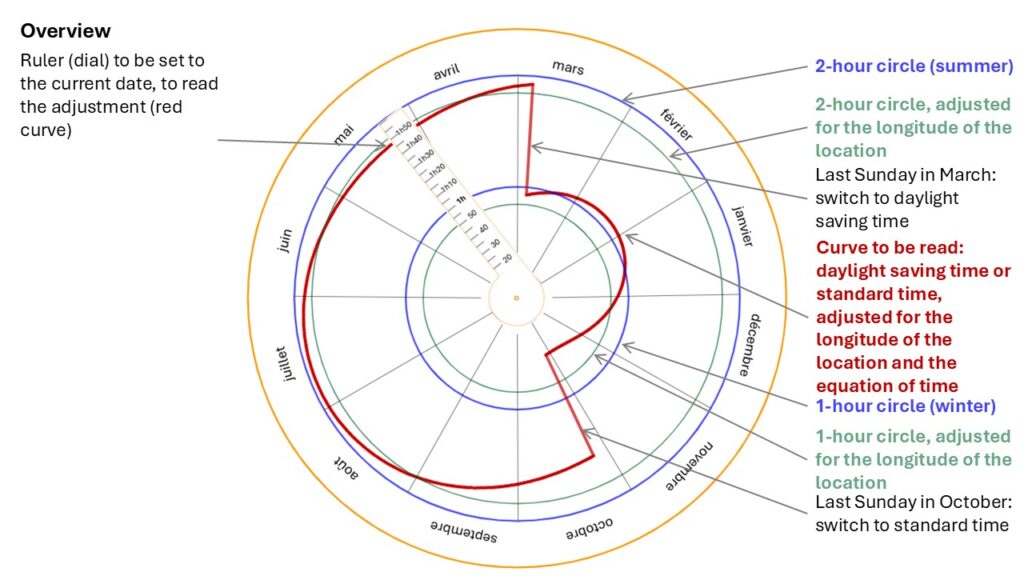
The Papophoplon can also answer a number of other questions:
- At what time is the Sun exactly South?
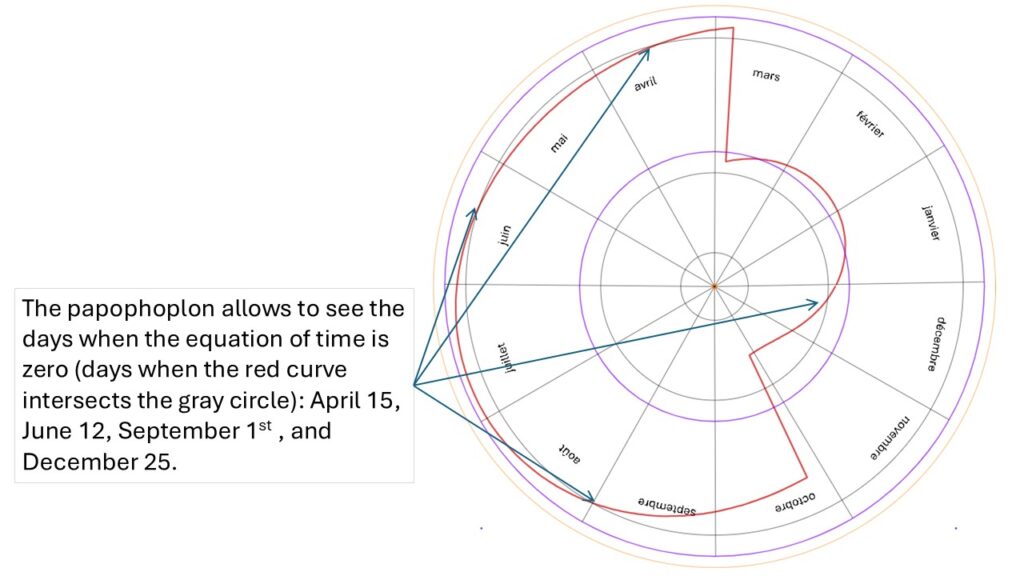
- On which days does the equation of time cancel out?
- Are there days when the difference between my watch and my sundial is a round number?
At what time is the Sun exactly South?
In other words: what time is it on my watch when it is solar noon? This is the first function of the papophoplon: since we know the difference between the watch and the dial and we know that the adjustment always consists of adding this difference to the dial time, we simply read this adjustment as the watch time.
For example, in the previous image, we read that on 10 May in Paris, we must add 1 hour 47 minutes to solar time. So at solar noon, it is 1:47 p.m. on the watch.
On which days does the equation of time cancel out?
Are there days when the difference between my watch and my sundial is a round number?
In other words, are there days when the difference between the watch and the sundial is exactly one hour (in winter) or exactly two hours (in summer)?
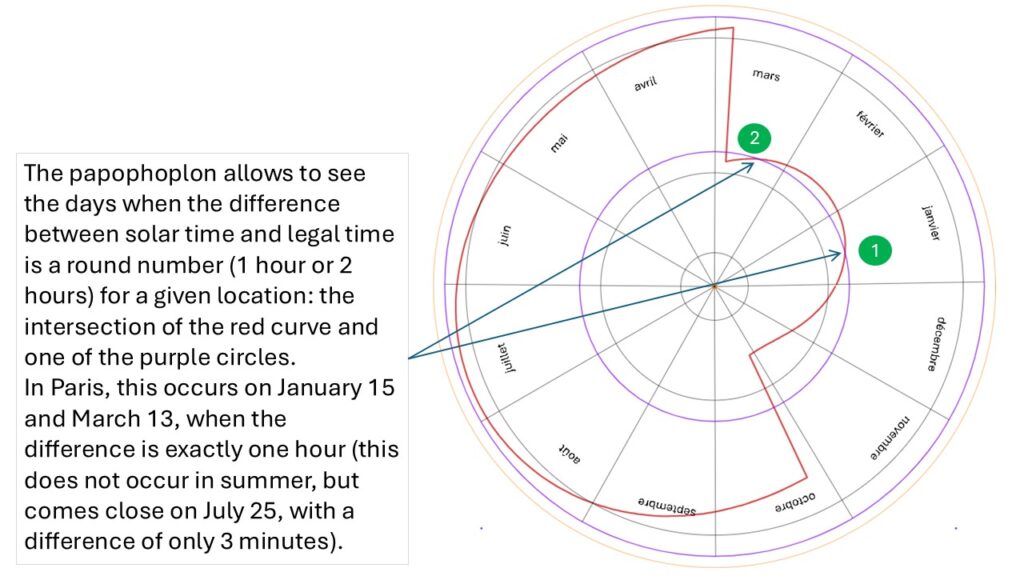
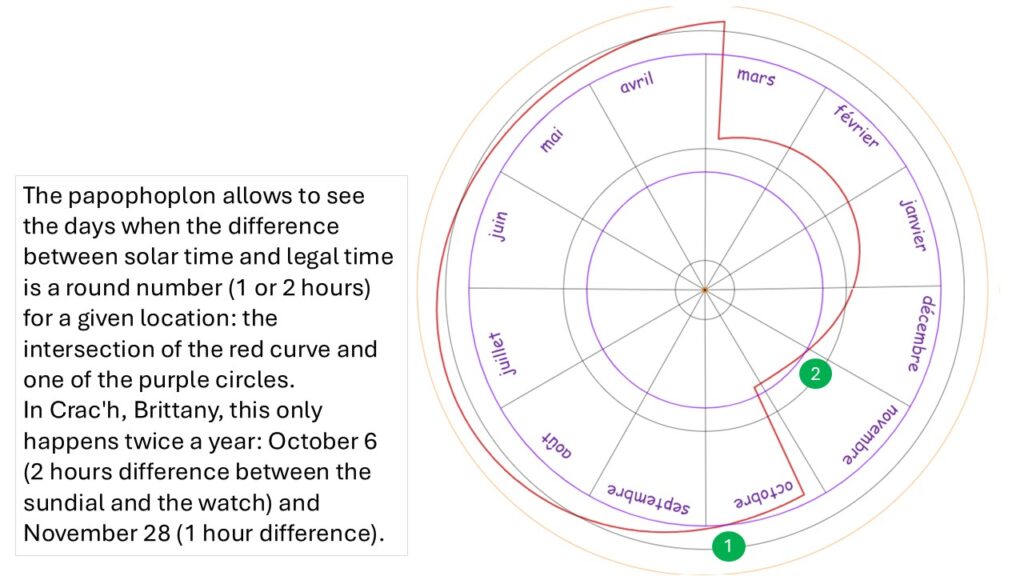
Such days depend, of course, on location. They correspond to days when the equation of time is exactly opposite to the longitude difference. In Paris (east of the Greenwich meridian), the equation of time must be positive. In Crac’h, Brittany (west of the Greenwich meridian), it must be negative.
In Greenwich, this occurs four times a year, when the equation of time is zero.
For locations more than 14 minutes east or more than 16 minutes west, this never occurs.
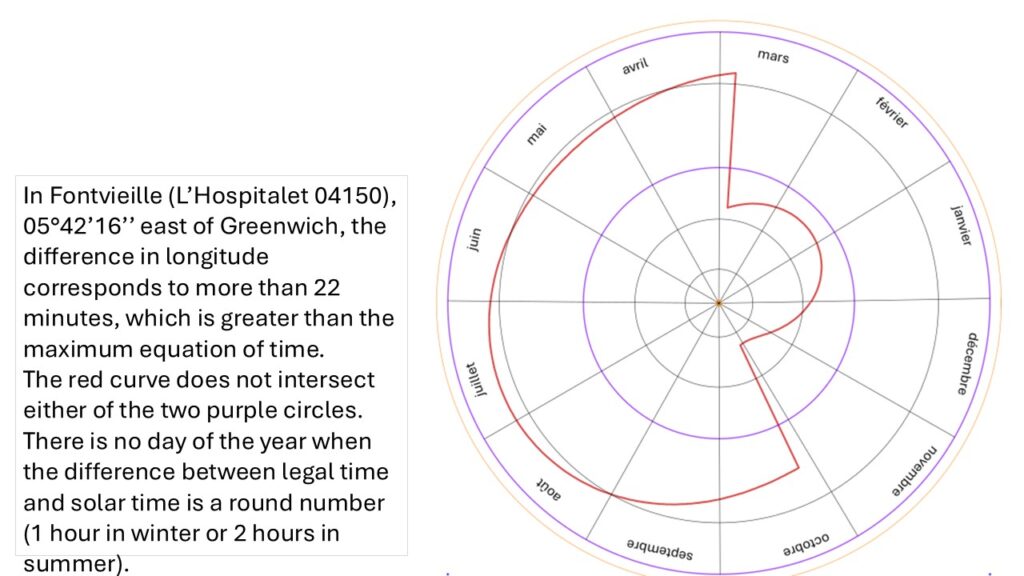
Photo of a papophoplon engraved on wood, for Fontvieille (at L’Hospitalet 04150), longitude: E 05°42’16”.
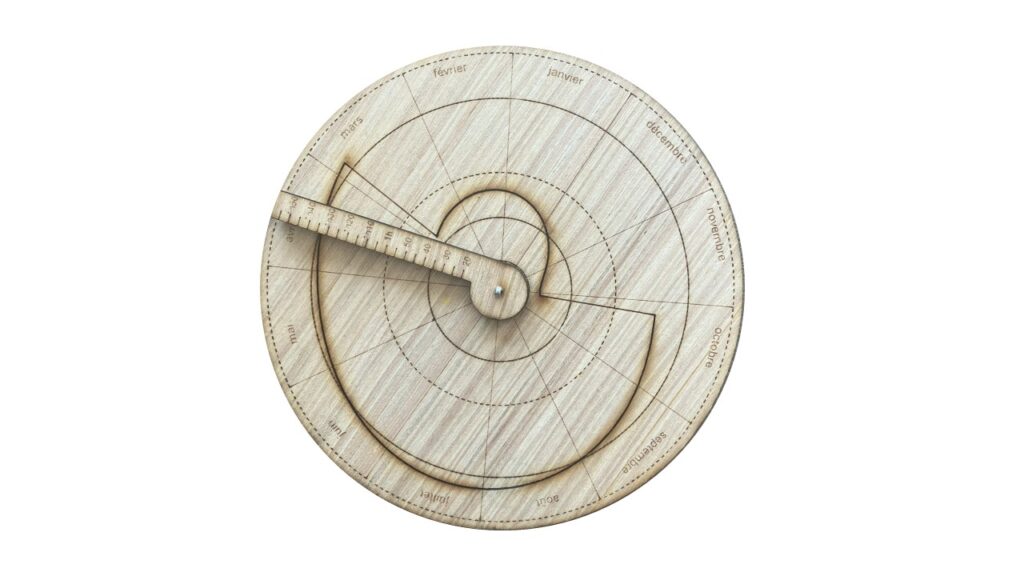
Patent application filed on 18 November 2025 (FR2514192).