In this article, we explain the three adjustments made by the Papophoplon.
1. Summer time or winter time?
The first difference between solar time and your watch comes from summer or winter time. The sun does not know that you set your watch forward one hour in summer. Nor does it know that the legal time in France is one hour ahead of ‘natural’ time.
This can be clearly seen on the map of legal time in Europe:
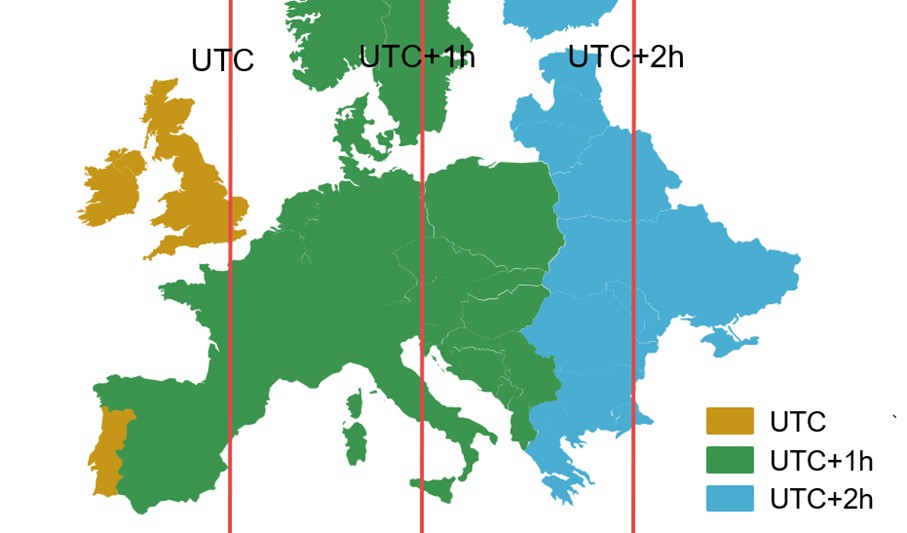
The Greenwich meridian (vertical red line labelled ‘UTC’) passes through France. However, France is UTC +1h, whose meridian passes slightly east of Berlin, Germany, and near Naples, Italy. The UTC+2 meridian passes through Saint Petersburg in the north and Kiev in the south.
In fact, France is on German time. This dates back to the Second World War, but that’s another story (read here). Spain is also on German time, for almost the same reasons.
Conclusion 1: relative to the sun, France is one hour ahead in winter and two hours ahead in summer. This is the first (and most important) correction to bring solar time closer to the time on your watch: add one hour in winter and two in summer.
2. Time difference from the reference meridian (Greenwich)
The map clearly shows that even if France were on UTC time, not all sundials in metropolitan France would be in the same situation. Those in Poitiers and Le Mans would be almost in line with legal time, but those in Brittany and Alsace would not:
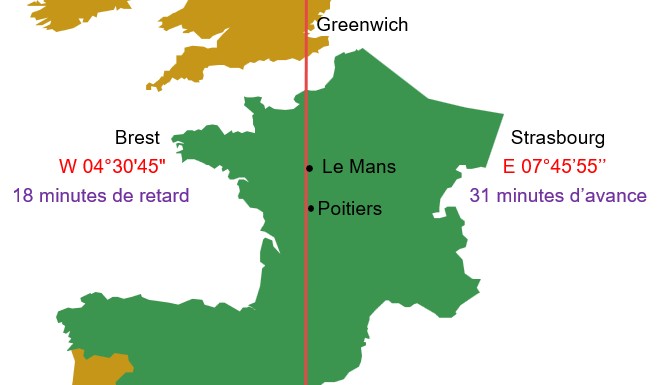
In France, there is a time difference of nearly one hour (49 minutes, to be precise) between Strasbourg and Brest. A sundial in Strasbourg will show noon 31 minutes earlier than a sundial in Le Mans, which is itself 18 minutes ahead of one in Brest.
This is, of course, due to the Earth’s rotation (towards the east): the Sun rises in the east and sets in the west.
This time difference can be calculated: an average day (24 hours) corresponds to one rotation, which gives 360° in 24 hours (i.e. 24×60 = 1440 minutes). One degree of longitude difference gives a 4-minute time difference. We can thus verify that the difference between Brest and Strasbourg (just over 12°) does indeed give a time difference of more than 48 minutes.
Conclusion 2: to find the time on the watch, you have to take into account the time difference between the location of the sundial and the meridian. You add it if you are to the west, since you are ‘behind’ the watch, and you subtract it if you are to the east. In Fontvieille, in the Alpes de Haute-Provence, where I am based, it is a considerable 23 minute-difference. In Paris, you have to subtract 8 minutes. Not insignificant!
Please note: some sundials are already ‘corrected’ to take longitude into account. To find out if your sundial is corrected, read here.
3. Difference between solar time and mean time: the equation of time
The third adjustment is more difficult to understand. The good news is that it is also the smallest: 16 minutes at most. If you are satisfied with such a level of accuracy, you can stop there.
But you are continuing to read, which makes me happy!
A simple way to understand this adjustment is to remember (1) that the Earth does not orbit the Sun in a circle, but in an ellipse, and (2) that it is tilted on its orbit. The Sun’s path across the sky is therefore not constant throughout the year. Because of these two facts, the length of a day is indeed 24 hours, but this is only an average over the year. This average is only true for four days of the year. The rest of the time, the day lasts a little more or a little less than 24 hours.
Our watches show the legal time, i.e. the average time. According to the old expression GMT, Greenwich Mean Time meant the average time in Greenwich. Today we call it UTC (Universal Time Coordinated). Legal time is defined by our watches, which are themselves set to different atomic clocks, all disconnected from the Earth’s rotation and therefore from solar time.
Solar time, on the other hand, is defined by the position of the Sun in the sky, as seen from the Earth. Let’s go back to basics: the Sun rises in the east and sets in the west. When it is in the south, it is halfway through its journey: this is midday. In more technical terms, midday is defined as the moment when the Sun passes the meridian of the place where we are. Noon is therefore necessarily local, as is solar time in general. The solar day is defined as the time between two passages of the Sun across the meridian.
To calculate noon, we do not care about the height of the Sun, only its direction in relation to the meridian. Thus, the Sun is at different heights at noon:
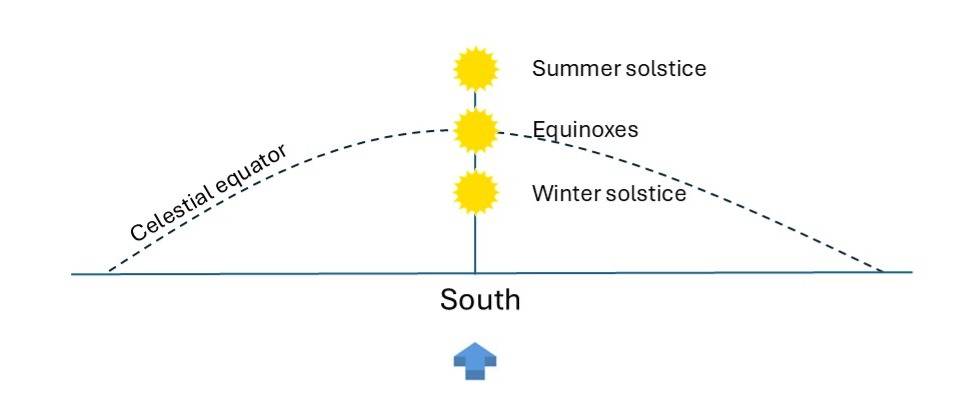
In other words, what matters in determining noon by the Sun is not the position of the Sun in the sky, but the projection of its position on the equator (orthogonal projection).
According to this definition, the day is not constant: the longest day lasts 24 hours and 22 seconds. The shortest day lasts 23 hours, 59 minutes and 32 seconds. At most, the difference is therefore a few seconds, but this daily difference accumulates over several weeks and results in a 15-minute advance or a 16-minute delay.
There are two reasons for this: ellipticity and obliquity.
Let’s look at the Earth’s rotation: it rotates on its axis in one day, while revolving around the Sun in one year. So, at the same time as it rotates on its axis, it moves along its orbit. For the Sun to return in the same direction as the day before, the Earth must therefore rotate a little more than once on its axis.
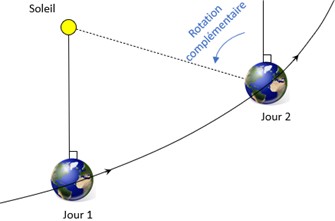
However, the duration of this catch-up is not constant throughout the year, for the two reasons mentioned above.
Ellipticity: the Earth does not revolve in a circle; its orbit is an ellipse.
Firstly, the Earth’s orbit is not a circle, but an ellipse (Kepler’s 1st law) and, furthermore, the speed at which the Earth travels in its orbit is not constant (Kepler’s 2nd law).
This is quite intuitive: if the Earth moves more quickly in its orbit, it will need to rotate more to bring the Sun back into the same direction. On 3 January (approximately), the Earth is closest to the Sun, so it moves faster to cover the same surface area in a day than when it is further away (Kepler’s 2nd law). And the Sun falls behind. Conversely, when it is furthest from the Sun, it moves slower than average and gains time.
Obliquity: the Earth is tilted on its orbit
In fact, even if the Earth followed a uniform circular motion, the length of the day would still vary. This is because the second component of the equation of time is due to the obliquity of the Earth’s orbit. We know that the Earth’s axis of rotation is tilted by about 23° (Note: this tilt is not entirely constant: see here).
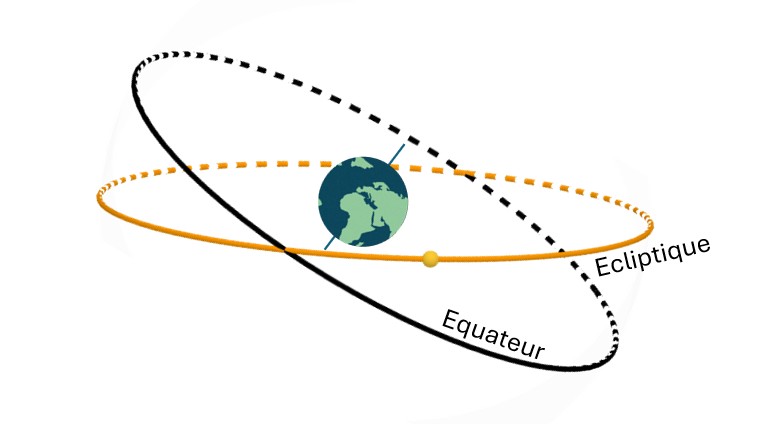
For us earthlings, it is as if the Sun revolved around the Earth on a slightly inclined plane: one revolution per day, but moving each day along the ecliptic (one revolution per year).
If we tilt the previous diagram slightly (positioning the equator horizontally), we see that the Sun appears to be at its highest above the equator on the day of the summer solstice and at its lowest below the equator on the day of the winter solstice. The apparent position of the Sun during the spring equinox is called the vernal point. On the other side, we see the position of the autumn equinox.
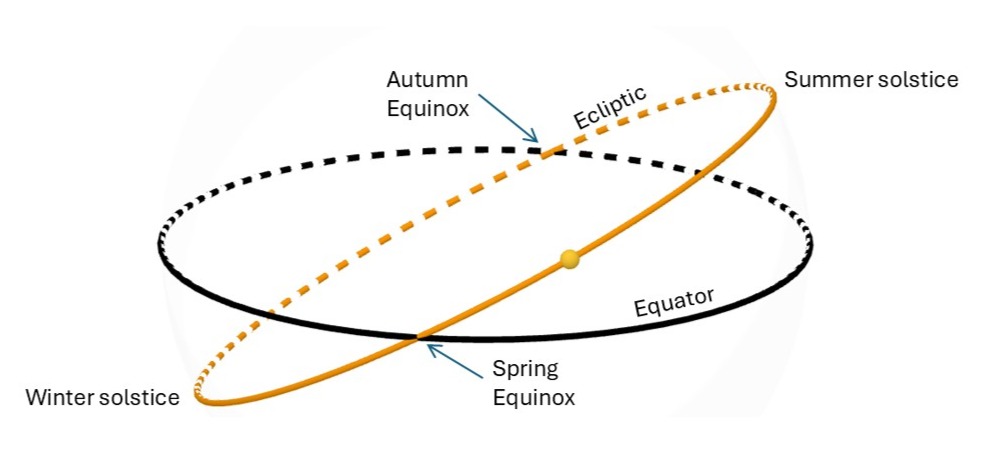
However, we saw above that what determines noon (in solar time, that is) is the projection of the Sun onto the equator. We also said that this is an orthogonal projection.
In the diagram below, we see the ‘true’ Sun rotating on the ecliptic in a uniform circular motion, at a speed of one revolution per year. We also see the mean Sun, which determines the time on our watches, rotating on the equator. The mean Sun also moves at a constant speed of one revolution per year. The true Sun and the mean Sun coincide at the equinoxes.
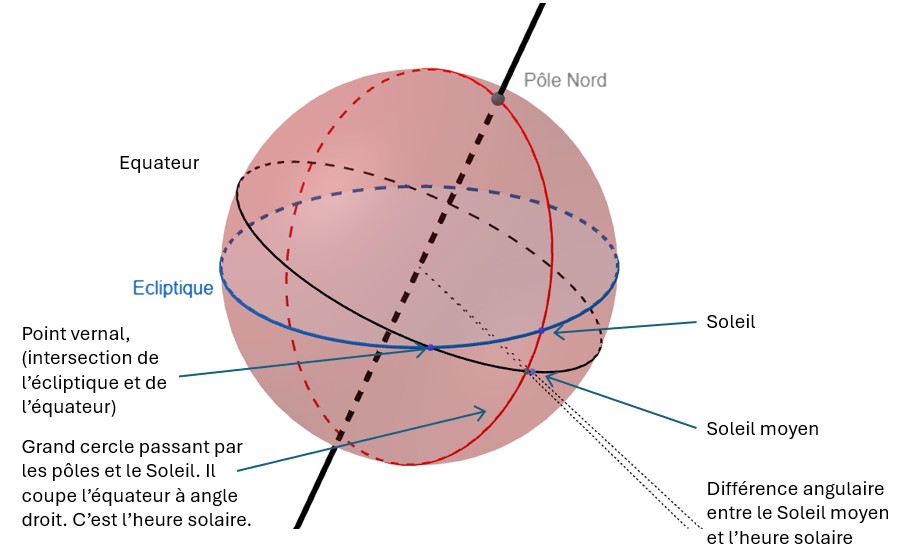
It is clear that the “true” Sun (the orthogonal projection of the Sun onto the Earth’s equator), which determines solar time, is offset from the mean Sun, which determines watch time.
To play with the Geogebra simulation, click here.
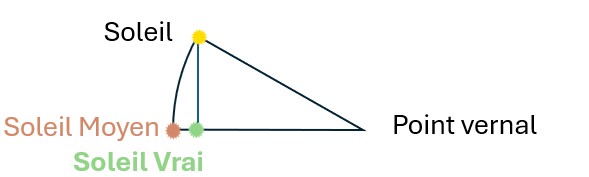
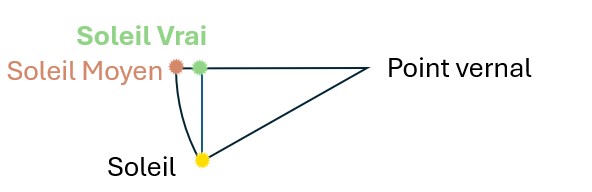
To calculate the angular difference we have just highlighted, let’s focus on the two spherical triangles at the heart of this drawing:
- The triangle [Vernal Point – Sun – Mean Sun] and
- The triangle [Vernal Point – Sun – True Sun]